

Quick Summary
- Properly sizing a commercial standby generator starts with your critical electrical load, not your total building load.
- Your Automatic Transfer Switch needs properly configured delay sequencing, not just a fast transfer time. This is the step most installations get wrong.
- Running a generator chronically below 30% of rated capacity causes wet stacking, which means bigger isn’t always better.
When North Jersey businesses ask us how to size a standby generator, most of the conversation goes the way you’d expect: kilowatts, critical loads, transfer switches. But there’s one step in the middle, ATS delay sequencing, that almost never comes up until something goes wrong.
Here’s the short answer up front: sizing a commercial standby generator means calculating your facility’s critical electrical load, adding a 25% reserve margin, and, just as importantly, configuring your Automatic Transfer Switch (ATS) with proper time-delay sequencing so the generator doesn’t get overloaded at the moment it’s needed most.
Get the math right and skip the sequencing, and you’ll have a generator that trips offline during the first major nor’easter. Get both right, and your facility stays open when everyone else is dark.
This guide walks through the full process, step by step.
What Is a Commercial Standby Generator System?
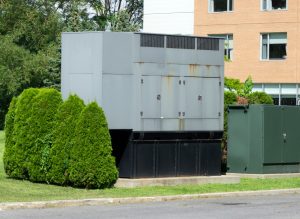
A commercial standby generator system has three main components: the generator (which produces power), the Automatic Transfer Switch (ATS), and the transfer wiring connecting both to your electrical panel.
When utility power fails, the ATS detects the outage, signals the generator to start, confirms stable voltage and frequency, then transfers your critical loads to generator power, automatically, without anyone flipping a switch. The whole sequence typically takes 15 to 30 seconds.
The generator and the ATS have to be sized and configured together. One without the other is an incomplete system.
Step 1: Calculating Your Facility’s Critical Load
This is where the process starts, and where the most common mistakes happen.
The Difference Between Critical Loads and Convenience Loads
Your total building electrical load and your critical load are two very different numbers.
Critical loads are the systems that must stay on during an outage: emergency lighting, fire alarm, security, HVAC (for temperature-sensitive spaces or medical offices), refrigeration, servers and network equipment, and any process equipment that can’t safely shut down mid-cycle.
Convenience loads are everything else: lobby lighting, break room appliances, decorative fixtures, and non-essential office equipment. These don’t need to run on generator power, and including them inflates your required generator size unnecessarily.
Most clients come to us with their full utility bill and assume we’ll base the generator size on peak demand. That’s not quite right. We’re sizing to what must run, not what does run.
How to Read Your Demand Data
Two methods give you an accurate picture of your critical load:
Utility bill demand data. Your electric bill shows peak demand in kilowatts (kW), usually the highest 15- or 30-minute average demand recorded over the past 12 months. This is your starting point, but it reflects your total load. You’ll need to subtract convenience loads to get to your critical number.
Clamp meter (ammeter) method. A licensed electrician installs a clamp meter on your service entrance to measure actual current draw across your critical circuits over time. This gives you real-world demand data rather than estimates.
For commercial buildings over 100 amps, the clamp meter approach gives you a more accurate number. It removes the guesswork before any equipment gets specified.
Step 2: Sizing the Generator to Your Load
Once you have your critical load in kW, you’re ready to size the generator. But there’s an important rule that gets quietly skipped in a lot of online guides.
The 25% Reserve Capacity Rule for Commercial Systems
A properly sized commercial standby generator should be rated at roughly 125% of your calculated critical load.
If your critical load totals 80 kW, you’re looking at a 100 kW generator, not an 80 kW unit running at full capacity.
That reserve exists for real reasons: electric motors draw 3 to 6 times their running amperage at startup, load fluctuates, and future additions are almost inevitable. A generator sized to exactly your current load has no margin for any of that.
Why Undersizing Is Dangerous, and Oversizing Has Hidden Costs
Undersizing is the obvious failure mode. An undersized generator gets overloaded at startup, trips its breaker, and leaves you without power at exactly the wrong moment.
But here’s what most sizing guides won’t say: oversizing carries a real mechanical risk.
When a diesel generator runs consistently below 30% of its rated capacity, it operates at too low a temperature to fully combust fuel. Unburned fuel deposits build up in the cylinder walls and exhaust system, a condition called wet stacking. Over time, wet stacking degrades engine performance, increases maintenance frequency, and shortens the generator’s service life.
The right answer isn’t the biggest generator you can find. It’s the correctly sized generator for your actual load profile, with a proper reserve margin, not an arbitrary buffer.
Step 3: How the ATS Manages the Switchover Safely
The Automatic Transfer Switch is the brain of your backup power system. Understanding how it works helps explain why configuration matters as much as the generator itself.
What Happens in the First 10–15 Seconds of an Outage
Here’s what the sequence looks like after utility power fails:
- 0 seconds: Utility voltage drops below threshold. The ATS detects the failure.
- 5–10 seconds: the ATS sends a start signal to the generator. Most commercial units are at operating speed within 10 seconds.
- 10–15 seconds: The generator reaches stable voltage and frequency (typically 120V ±2% and 60 Hz ±0.5%).
- Transfer: The ATS opens the utility connection and closes the generator connection. Critical loads come online.
Total time from outage to restored power: 15 to 30 seconds on a properly configured system.
Open-Transition vs. Closed-Transition Transfer Switches
Most commercial facilities use an open-transition ATS, which briefly disconnects from both the utility and generator during transfer. There’s a moment, usually less than a second, with no power. For most applications, this is completely acceptable.
Closed-transition switches overlap utility and generator power momentarily, allowing a break-free transfer. This is standard for hospitals, data centers, or any facility where even a fraction-of-a-second interruption causes problems.
For most North Jersey commercial facilities, offices, restaurants, and light industrial, an open-transition ATS is the right choice. The added cost of closed-transition equipment is only justified when the load genuinely can’t tolerate any gap.
Working through this on your own and not sure where to start? Our team is happy to walk through a load analysis with you, contact Paxos Electric for a free estimate, no pressure.
Step 4: Why ATS Delay Sequencing Is the Most Overlooked Part of the System
This is the section you won’t find in most generator sizing guides. It’s also the step that separates a properly commissioned system from one that fails at the worst possible moment.
What Happens When All Loads Hit the Generator at Once
When your ATS transfers power to the generator, every critical load in the facility tries to start at the same instant. HVAC compressors, refrigeration units, servers, and emergency lighting are all pulling current simultaneously.
The combined startup surge can exceed the generator’s short-term capacity, causing a voltage dip. Severe enough, and the generator’s automatic protection trips it offline. You’ve survived the outage, transferred to backup power, and lost it again, all within 30 seconds.
That’s not a generator failure. That’s a sequencing failure. And it’s preventable.
How Staged Time-Delay Sequencing Protects Your System
Properly configured ATS load sequencing staggers the startup of your critical loads across timed intervals:
- Stage 1 (0 seconds after transfer): Life-safety loads, emergency lighting, fire alarm, security systems.
- Stage 2 (+5 seconds): HVAC systems, refrigeration compressors.
- Stage 3 (+10 seconds): Server rooms, process equipment, remaining critical loads.
Each stage waits for the previous group to stabilize before the next one comes online. The generator never sees the full surge demand at once. Voltage stays stable. The system stays online.
The specific timing and stage assignments depend on your facility’s load profile, which is why ATS commissioning by a licensed electrician isn’t a formality. It’s what determines whether your backup power system actually performs when it’s called on. Per NFPA 110 (Standard for Emergency and Standby Power Systems), emergency power systems must be tested under load and verified as designed, and sequencing is part of that verification.
Do You Need a Permit for Commercial Generator Installation in New Jersey?
Yes. A commercial standby generator installation in New Jersey requires an electrical permit from your local municipality, and the work must be performed by a licensed electrical contractor. The permit covers the installation, ATS wiring, and a final inspection.
Your contractor handles the permit process as part of the job; it’s not an add-on or an afterthought.
If someone offers to install a commercial generator without pulling a permit, that’s a serious red flag. Unpermitted work creates liability, voids equipment warranties, and causes real problems when the property changes hands. Working with a licensed contractor, one with experience navigating permits across Morris County and surrounding North Jersey municipalities, means this gets done correctly from the start.
Kohler vs. Generac: Which Commercial Generator Is Right for Your Facility?
We’re authorized dealers for both Kohler and Generac, and this question comes up on nearly every commercial job. The honest answer: both are excellent brands with strong commercial product lines.
Kohler commercial generators are known for their build quality and long-term reliability, and they’re particularly well-suited for critical facilities, medical offices, data centers, and applications that need high performance over extended run times. Their industrial controllers offer detailed load monitoring and sequencing flexibility.
Generac commercial units offer a strong balance of performance and value, with a wide kW range covering most light industrial and commercial applications. For restaurants, office buildings, and multi-tenant properties, Generac is often the right fit.
The decision comes down to your load profile, runtime requirements, and service considerations, not brand preference. We’ll recommend what’s right for your facility.
The Four Steps, and What Comes Next
Sizing a commercial standby generator is a four-step process: calculate your critical load, size to 125% of that number, understand how your ATS manages the transfer, and, critically, make sure delay sequencing is configured for your specific load profile.
Here’s what that means for your facility: this isn’t a project to hand off to whoever has the lowest quote. The load analysis, ATS commissioning, permit coordination, and load bank testing that go into a proper installation require a licensed electrician who’s done this work before.
According to NJ BPU performance data, JCP&L, which serves Morris County and much of the surrounding North Jersey grid, has historically ranked among the worst utilities in the state for average outage duration per customer. That’s not a scare tactic; it’s the operating reality for businesses in this region. A properly installed, properly configured system means you’ve already made the decision before the next storm makes it for you.
North Jersey Note
Morris County and surrounding areas are served by JCP&L (Jersey Central Power & Light), which has ranked among New Jersey’s lowest-performing utilities for outage duration per customer, per NJ Board of Public Utilities performance data. Nor’easters, ice storms, and summer grid stress events are routine here. That context matters when you’re evaluating whether standby power is worth the investment.
Get a Free Estimate From Paxos Electric
Paxos Electric Company has been sizing and installing commercial standby generators in Wharton, NJ, and surrounding Morris County since 2004. We’re authorized Kohler and Generac dealers, licensed in New Jersey, and A+ rated by the Better Business Bureau.
We start every commercial generator project with a load analysis, so you know exactly what size system your facility needs before any equipment gets ordered.
Contact us for a free estimate, and we’ll walk through the process with you.
Written by the team at Paxos Electric Company, licensed commercial electricians and authorized Kohler & Generac dealers serving Wharton, NJ, and surrounding Morris County since 2004.
Frequently Asked Questions
How do I calculate the right generator size for my commercial building?
Start by identifying your critical loads, the systems that must stay on during an outage, such as emergency lighting, HVAC, refrigeration, and servers. Calculate the total kW demand of those loads using your utility bill demand data or a clamp meter reading taken at your service entrance. Then add 25% as a reserve margin. A facility with 80 kW of critical load needs a generator rated at approximately 100 kW. A licensed electrician can perform a formal load analysis to confirm the number before any equipment is specified.
What is ATS delay sequencing, and why does my generator need it?
ATS delay sequencing staggers the startup of your critical loads after the transfer switch connects the generator. Without sequencing, all loads attempt to start at the same moment, creating a combined startup surge that can trip the generator offline. Staged time-delay settings, typically 5 to 10 seconds between load groups, allow the generator to stabilize before each new set of loads comes online. These settings are configured during ATS commissioning and must be matched to your facility’s specific load profile to be effective.
Do I need a permit to install a commercial standby generator in New Jersey?
Yes. Commercial generator installations in New Jersey require an electrical permit from your local municipality, and all work must be performed by a licensed electrical contractor. The permit covers the installation, transfer switch wiring, and a final inspection confirming code compliance. A licensed contractor handles the permit process as part of the job. This ensures the installation meets current NEC standards and local requirements, and protects you from liability associated with unpermitted electrical work.
 Aluminum Wiring in Your North Jersey Home: What’s Actually Happening Inside Your Walls